VTC driver exam in Madrid 2026: syllabus, tests and mock exams
This page matches the test regulated by the Orden de 28 de marzo de 2025 and the 2026 and 2027 exam calls.
The exam is in Spanish. This page in English helps you understand the exam and our study pack. In the English PDF every chapter is translated; the test questions stay in Spanish, as in the exam, with the English translation below and the explanation in English. Your purchase also includes the Spanish PDF.
Complete study pack · VTC driver exam in the Madrid region
The 4 modules of the exam, explained, with tests
You have not been charged. If you want to look at it more closely first, download a sample chapter or take the free test. If the payment gave you any problem, write to us at oposiciones@psicopedagogia.com and we will sort it out.
311 pages in PDF and web · 857 questions to practise · 4 mock exams of 60 questions
Next exam with places: 26 November 2026 · see dates (in Spanish)
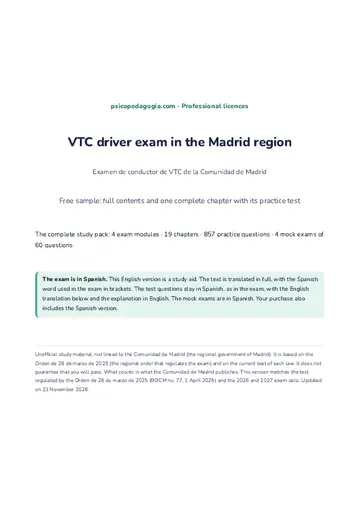
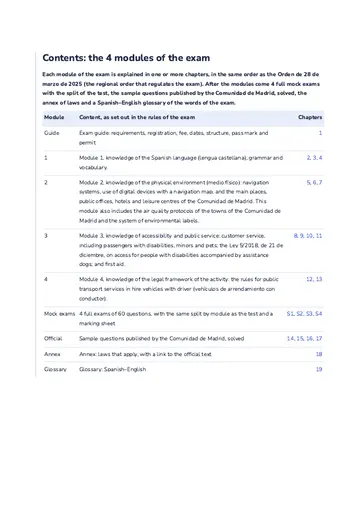
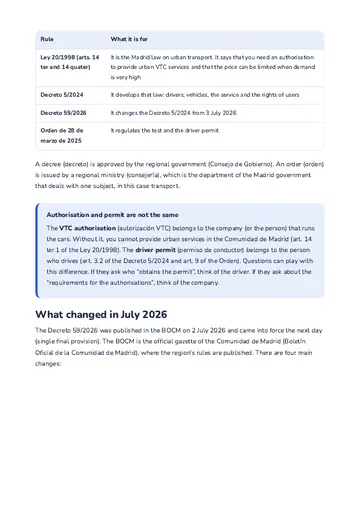
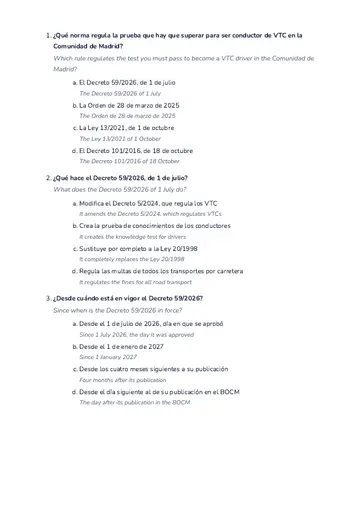 See inside · view sample
One-off payment, VAT included, no subscription. You get it straight away.
Secure payment with Stripe: card, Apple Pay or Google Pay.
- You get the PDF and the web version straight away, without creating an account
- Stripe invoice in your email, straight away
- If the rules of the exam change, we update it for free
If it is not useful to you, we will refund your money within 14 days.
- You get the complete study pack in 5 PDFs: English, Spanish, French, Romanian and Arabic, at no extra cost
- Every fact with its article of the law, and every question with the answer explained
- PDF to print and web version for your phone
- 4 mock exams of 60 questions, in Spanish as in the real exam, with the same split by module and a sheet to check if you pass every module
- Share it with up to 2 people close to you: split three ways, it costs 9,97 € each
Share on WhatsApp
In a nutshell
- To work as a VTC driver in the Comunidad de Madrid, you must pass a multiple-choice exam of 60 questions and 60 minutes, with four modules (parts): Spanish language, physical environment, accessibility and public service, and VTC rules. The exam is in Spanish.
- You pass with at least half of the answers right in each module: 6 out of 12, 9 out of 18, 9 out of 18 and 6 out of 12. The average does not count: if you fail one module, you repeat the whole test.
- Our study pack costs €29.90, paid once. It explains the four modules in English and includes four mock exams with the real split of questions. The questions stay in Spanish, as in the exam, with a translation underneath. It is unofficial material and does not guarantee a pass.
On this page
- The VTC driver exam, fact by fact
- Who can take it and how to register
- Syllabus: the 4 modules of the exam
- Free test: 20 questions from the 4 modules
- What the full PDF includes
- What the study pack gives you that the free questions do not
- How to prepare for the exam in a few weeks
- Frequently asked questions
- Sources
You want to work as a VTC driver in the Comunidad de Madrid (the regional government of Madrid). A VTC (vehículo de arrendamiento con conductor, hire vehicle with driver) is a car with a driver that you book before getting in, for example with an app. To drive one as a job, you must pass a multiple-choice exam. This page tells you what the exam is like and what our study pack includes. Below, you have 20 free questions to see how you are doing. It is written to be read on your phone, with short sentences.
Important: the exam is in Spanish, and module 1 tests your Spanish. So this English version is a help to understand and study. The questions stay in Spanish, as in the exam, with the English translation underneath. The explanations are in English. Spanish names of laws, offices and places in Madrid appear in Spanish, with a short explanation the first time.
The VTC driver exam, fact by fact
Every fact has its source, so you can check it.
| Fact | What the rule says |
|---|---|
| Questions | 60 multiple-choice questions, with four options and only one correct (rule one of the 2026 and 2027 exam calls; art. 2.1 of the Orden sets a maximum of 60) |
| Time | 60 minutes, written exam (rule four of the 2026 and 2027 exam calls) |
| Modules | Four, with 12, 18, 18 and 12 questions (art. 2.2 of the Orden) |
| To pass | At least 50 % right answers in each module: 6, 9, 9 and 6 (art. 3.1 of the Orden) |
| Result | «Apto» (pass) or «no apto» (fail) (art. 3.2 of the Orden) |
| If you fail | You repeat the whole test (art. 3.3 of the Orden) |
| How often it is held | At least 12 times a year (art. 4.1 of the Orden) |
| Registration | Online, open all year (art. 6 of the Orden and rule three of the 2026 and 2027 exam calls) |
| Fee | €31.38 (online office of the Comunidad de Madrid) |
| On exam day | A valid identity document; mobile phones and other electronic devices are not allowed (rule four) |
| The permit, once passed | It lasts five years and is renewed without repeating the test (art. 11 of the Orden) |
A «module» is each of the four parts of the exam. Here is what surprises people most: there is no average. Imagine that in module 2 you get 8 of 18 right. You need 9. Even if you answer everything correctly in the other three, you get «no apto» and repeat all four.
Neither the Orden nor the exam call says that wrong answers lose points. This is our own check: it does not appear in the text we have read.
The full guide is in what the VTC driver exam in Madrid is like (in Spanish).
Who can take it and how to register
To register, you pay the fee and declare on the form that you meet these conditions (procedure L252 of the online office and art. 3.1 of the Decreto 5/2024, the regional decree on VTC):
- You have had a class B driving licence (permiso de conducir de clase B) for at least two years.
- You have no infectious disease and no physical or mental condition that stops you working as a driver, and you do not regularly use drugs or alcohol.
- You have not been convicted of crimes against sexual freedom.
- You have no other job that affects the way you drive.
To submit the application you need an electronic certificate (or an online signature system accepted by the Comunidad de Madrid), according to rule three of the 2026 and 2027 exam calls. Without one of those systems, you cannot send the form.
Note this difference. To sit the exam, the online office does not ask for a course or a company. To work, it does: art. 3.1.b of the Decreto 5/2024 requires you to be on the staff of a company, registered with Social Security (Seguridad Social). To apply for the permit after passing, art. 9 of the Orden says you must prove the other conditions of art. 3.1. The online office page for applying for it (procedure L253) does not name the company among the requirements and only asks for a photo and the receipt for the fee.
You do not choose the date. The Comunidad de Madrid gives you a place in the next exam session with free places. You cannot change that date, except for a serious and unexpected reason that you can prove (rule three, base tercera, of the 2027 exam call). That is why the exam call says not to submit the application if you cannot attend on the date that the official website shows as the next one.
The steps, one by one, are on requirements and steps for the VTC driver permit (in Spanish) and the dates are on exam dates and how to register (in Spanish).
Syllabus: the 4 modules of the exam
The Comunidad de Madrid does not publish a manual or a developed syllabus. It only says what each module contains (art. 2.2 of the Orden). Our syllabus follows that order and those names.
| Module | What the Orden says | Questions | Minimum to pass |
|---|---|---|---|
| 1. Spanish language (Lengua castellana) | Grammar and vocabulary (gramática y léxico) | 12 | 6 |
| 2. Physical environment (Medio físico) | Navigation systems, use of digital devices with a map, the main places, public offices, hotels and leisure centres of the Comunidad de Madrid, the air quality protocols of its towns and the environmental labels | 18 | 9 |
| 3. Accessibility and public service (Accesibilidad y servicio público) | Customer service, passengers with disabilities, minors and pets, assistance dogs and first aid | 18 | 9 |
| 4. Legal framework (Marco jurídico) | Rules that regulate VTC transport | 12 | 6 |
What the PDF contains:
- Exam guide. Who can take the exam, how to register, the fee, how the date is assigned, the minimum mark, what happens if you fail and how to apply for the permit afterwards.
- Module 1. Grammar and job vocabulary: prepositions, spelling, synonyms and antonyms, proverbs and reading comprehension. These are the topics of the samples that the Comunidad de Madrid publishes. The language examples stay in Spanish, and the explanations are in English.
- Module 2. How to use a navigation app with a map, places and offices of interest, the DGT environmental labels, the low-emission zones and the air quality protocols. Every fact about Madrid has its official source with a link.
- Module 3. Helping a passenger with a disability, travelling with a minor, an assistance dog in the car and what to do if there is an accident with injured people.
- Module 4. The Decreto 5/2024, the Decreto 59/2026 that changed it in July, the Ley 20/1998, the Ley 16/1987 (LOTT) and the Ley 13/2021, with the article for each fact.
- Four mock exams of 60 questions, with the real split of the exam and a sheet to know whether you get «apto» in each module.
- Sample questions from the Comunidad de Madrid, solved. Each with its source document and the date it was checked. The official questions stay in Spanish, word for word, with our own translation next to them, marked as not official.
- Annex of rules, with the link to the official text of each law.
- Glossary from Spanish into English of the terms that appear in the exam.
Each topic ends with «Lo que más se pregunta» (what is asked most), a short summary to review.
Two warnings that the PDF explains:
- The Decreto 101/2016 no longer exists. It regulated the badges (stickers) of the cars, and the Decreto 59/2026 repealed it, that is, it took it out of force. The 2027 exam call still names it, so we explain what the new rule says and what happened to the old one.
- The assistance dogs law. The Orden mentions the «Ley 5/2018, de 21 de diciembre». That law belongs to Castilla-La Mancha. The law of the Comunidad de Madrid on the same subject is the Ley 2/2015, de 10 de marzo. We explain both.
Free test: 20 questions from the 4 modules
There are five questions per module, like a small practice exam. They are our own questions: they are not real exam questions. Each answer explains why it is the right one and quotes its law or source, checked in the original text.
As in the exam, the question and the options are in Spanish. Under each one you have the English translation, in italics. In module 1, the options are not translated, because they are the language examples you are being tested on.
When you get one wrong, read the explanation before moving on. That is what really teaches you.
Want more? You have more free questions in the VTC exam test (in Spanish), by module. The index of the professional licences section (in Spanish) takes you to the other guides.
What the full PDF includes
- The exam guide, step by step: requirements, registration, fee, date, minimum mark, what happens if you fail and how to apply for the permit.
- The four modules explained with short sentences. Every difficult word is explained the first time it appears.
- A test at the end of each topic, with the answer explained: why it is the right one and what it is based on (the law and the article or, for language and places, the source).
- Four mock exams of 60 questions, made for 60 minutes and with the same split as the exam: 12 on language, 18 on physical environment, 18 on accessibility and public service and 12 on VTC rules. Each mock exam is marked by module, so you know whether you get «apto» in each one (6, 9, 9 and 6).
- The sample questions from the Comunidad de Madrid, solved one by one. They are quoted with their source document. If an official answer looks wrong or older than a change in the rules, we tell you separately and keep the official answer as it is.
- An annex of rules, with the link to the official text of each law.
- A glossary from Spanish into English.
- A web version to review from your phone.
The price is €29.90, VAT included. You pay once, with no subscription and no expiry date: the PDF is yours. If it is not useful to you, we refund your money within 14 days. You can download it to study offline or print it. Before deciding, you can download one free sample topic.
What the study pack gives you that the free questions do not
The Comunidad de Madrid publishes a free sample of example questions with their answers. By our count there are 442: 202 in the four samples by module and 240 in four example exams (some may be repeated). They are on its page for the VTC driver tests (in Spanish). Use them: they are official material.
But those questions only give the correct letter. They do not say why, or which law it is in, or what is asked most. There is no manual either. That is what we add:
- The explanation of each answer, with the law and the article (or the source, in the language and places questions). This way you understand the rule instead of learning the letter by heart.
- A syllabus ordered by the modules of the Orden, so you always know how much you have left in each one.
- Simple language: short sentences, one idea in each sentence and examples from the job, such as a customer with a guide dog or a car stopped at a station.
- Mock exams with the same split as the exam, to practise the full 60 minutes.
- Update date and exam version, always visible. When a rule changes, like the Decreto 59/2026 in July, the study pack includes it and says so.
- A Spanish-to-English translation of each question and a glossary, so you can study the content in English and still get used to the Spanish of the exam.
How to prepare for the exam in a few weeks
There is no single plan. This is a proposal for four weeks, with about 30 minutes a day. Adjust it if you have more or less time.
- Week 1Module 4: VTC rules, with a test every day
- Week 2Module 3: customer service and first aid
- Week 3Module 2: places, navigation and labels
- Week 4Module 1 and one 60-minute mock exam
- Before the examMock exams and review of your weakest modules
Three ideas that help:
- Start with what is hardest. You need half the questions in each module, so your weakest module decides the result. Modules 2 and 3 are the longest: 18 questions each, 60 % of the exam between the two.
- Answer before looking at the solution. Answering with the book closed is remembered better than rereading. In the guide on how to take a multiple-choice exam (in Spanish) you have tricks for sharing out your time.
- Review what you get wrong. Note down each mistake with its law and come back to it a few days later. This is spaced repetition (in Spanish), and it works just as well for the name of a hospital as for an article of a law.
If Spanish is not your first language, read the Spanish questions aloud, then read the English translation, and underline the words you do not know. Module 1 tests exactly that: the Spanish you use every day at work.
Frequently asked questions
How many questions does the Madrid VTC exam have, and how long is it?
It has 60 multiple-choice questions, with four options and only one correct answer, and it lasts 60 minutes (rules one and four, bases primera y cuarta, of the 2026 and 2027 exam calls). They are split into four modules: 12, 18, 18 and 12 questions (art. 2.2 of the Orden de 28 de marzo de 2025).
What score do I need to pass?
At least 50 % of the questions in each module: 6 in module 1, 9 in module 2, 9 in module 3 and 6 in module 4 (art. 3.1 of the Orden). The modules are not averaged. The final result is «apto» (pass) or «no apto» (fail) (art. 3.2).
What happens if I fail just one module?
You get «no apto» (fail) and you must repeat the whole test, including the modules you had passed (art. 3.3 of the Orden). That is why the mock exams are marked module by module.
What requirements do I need to take the exam?
You pay the fee and declare on the application that you have had a class B driving licence (permiso de conducir de clase B) for at least two years, that you have no physical or mental condition that stops you doing the job and do not regularly use drugs or alcohol, that you have not been convicted of crimes against sexual freedom, and that you have no other job that affects your driving (online office of the Comunidad de Madrid, procedure L252, and art. 3.1, letters a, c, d and e, of the Decreto 5/2024). The online office does not ask for a prior course or a company in order to sit the exam.
How much does it cost to take the exam?
The exam fee is €31.38 and you pay it before sending the application. Once you have passed, issuing the permit is paid separately: €20.37 (online office, procedures L252 and L253). Our study pack is independent of these fees.
Are the questions in the study pack the ones in the real exam?
No. We wrote the practice questions ourselves and they are not real exam questions. The questions of the official test are not published in full: the Comunidad de Madrid only publishes a sample (art. 2.3 of the Orden). When we use questions from that sample, we say which document they come from.
Is it official material? Does it guarantee that I will pass?
It is not official material and it has no link with the Comunidad de Madrid. We made it from the Orden de 28 de marzo de 2025 and from the text of each law. No material guarantees a pass: what counts is what the Comunidad de Madrid publishes on its online office.
Will it still be useful if the exam changes in 2027?
The 2027 exam call keeps the same exam: 60 questions, four modules and 60 minutes (rules one and four). The Comunidad has put out to tender a booth-based exam system (BOCM of 25 September 2026), but on 23 November 2026 it has not yet chosen a company and there is no start date for the public. While the exam is governed by the Orden de 28 de marzo de 2025, updates to the study pack are free. If a new rule changes the modules or the marks, we will say so on this page.
What do I get for €29.90, and how do I receive it?
A PDF with the exam guide, the four modules, tests with the answer explained, four mock exams of 60 questions and an annex of rules, plus a web version to read on your phone. You pay once, VAT included, with no subscription, and you receive it straight away. If it is not useful to you, we refund your money within 14 days.
When is the next exam and how do I register?
Registration is open all year and you are given a place in the next exam session with free places (rule three, base tercera, of the 2027 exam call). The Comunidad de Madrid publishes the next date with free places on its website. We explain it step by step on the page about exam dates and how to register for the VTC exam (in Spanish).
Sources
- Consejería de Vivienda, Transportes e Infraestructuras de la Comunidad de Madrid (2025). Orden de 28 de marzo de 2025, por la que se regula la prueba para el ejercicio de la profesión de conductor de vehículos de arrendamiento con conductor en la Comunidad de Madrid (arts. 1 a 4, 6, 9 y 11). Boletín Oficial de la Comunidad de Madrid, n.º 77, de 1 de abril de 2025. bocm.es/boletin/CM_Orden_BOCM/2025/04/01/BOCM-20250401-34.PDF
- Dirección General de Transportes y Movilidad de la Comunidad de Madrid (2025). Resolución de 17 de diciembre de 2025, por la que se convocan las pruebas para el ejercicio de la profesión de conductor de VTC en el año 2026 (bases primera a cuarta). Boletín Oficial de la Comunidad de Madrid, n.º 304, de 22 de diciembre de 2025. bocm.es/boletin/CM_Orden_BOCM/2025/12/22/BOCM-20251222-20.PDF
- Dirección General de Transportes y Movilidad de la Comunidad de Madrid (2026). Resolución de 29 de octubre de 2026, por la que se convocan las pruebas para el ejercicio de la profesión de conductor de VTC en el año 2027 (bases primera a sexta). Boletín Oficial de la Comunidad de Madrid, n.º 271, de 11 de noviembre de 2026. bocm.es/boletin/CM_Orden_BOCM/2026/11/11/BOCM-20261111-21.PDF
- Consejo de Gobierno de la Comunidad de Madrid (2024). Decreto 5/2024, de 10 de enero, por el que se desarrolla la Ley 20/1998 en materia de arrendamiento de vehículos con conductor (arts. 3, 4, 7, 8 y 10). Boletín Oficial de la Comunidad de Madrid, n.º 9, de 11 de enero de 2024. bocm.es/boletin/CM_Orden_BOCM/2024/01/11/BOCM-20240111-1.PDF
- Consejo de Gobierno de la Comunidad de Madrid (2026). Decreto 59/2026, de 1 de julio, por el que se modifica el Decreto 5/2024 (nuevos arts. 4.4, 4.5, 7 y 8 bis; deroga el Decreto 101/2016). Boletín Oficial de la Comunidad de Madrid, n.º 156, de 2 de julio de 2026. bocm.es/boletin/CM_Orden_BOCM/2026/07/02/BOCM-20260702-1.PDF
- Comunidad de Madrid (2026). Pruebas para obtener el permiso de conductor de vehículos de arrendamiento con conductor (VTC), trámite L252 (requisitos, inscripción y tasa de 31,38 €; capturado el 22 de noviembre de 2026). Sede electrónica de la Comunidad de Madrid. sede.comunidad.madrid/autorizaciones-licencias-permisos-carnes/pruebas
- Comunidad de Madrid (2026). Permiso de conductor de vehículos de arrendamiento con conductor (VTC), trámite L253 (requisitos, documentación y tasa de expedición de 20,37 €; capturado el 22 de noviembre de 2026). Sede electrónica de la Comunidad de Madrid. sede.comunidad.madrid/autorizaciones-licencias-permisos-carnes/permiso
- Comunidad de Madrid (2026). Pruebas de conductor VTC: información, muestras de preguntas por módulo y ejemplos de prueba (actualizada el 19 de noviembre de 2026). Portal de la Comunidad de Madrid. comunidad.madrid/transporte/pruebas-conductor-vtc
- Comunidad de Madrid (2026). Anuncio de licitación del contrato de implantación, gestión y puesta en marcha de un sistema de autoexamen en cabinas para las pruebas de conductores de VTC. Boletín Oficial de la Comunidad de Madrid, n.º 229, de 25 de septiembre de 2026. bocm.es/boletin/CM_Orden_BOCM/2026/09/25/BOCM-20260925-27.PDF
- Ministerio de la Presidencia (2003). Real Decreto 1428/2003, Reglamento General de Circulación (texto consolidado, actualización de 26 de junio de 2026; arts. 18, 117, 119 y 129; consultado el 23 de noviembre de 2026). Boletín Oficial del Estado. boe.es/buscar/act.php?id=BOE-A-2003-23514
- Jefatura del Estado (1987). Ley 16/1987, de 30 de julio, de Ordenación de los Transportes Terrestres (texto consolidado; art. 48). Boletín Oficial del Estado. boe.es/buscar/act.php?id=BOE-A-1987-17803
- Jefatura del Estado (2021). Ley 7/2021, de 20 de mayo, de cambio climático y transición energética (texto consolidado; art. 14.3; actualización de 30 de junio de 2026). Boletín Oficial del Estado. boe.es/buscar/act.php?id=BOE-A-2021-8447
- Comunidad de Madrid (2015). Ley 2/2015, de 10 de marzo, de Acceso al Entorno de Personas con Discapacidad que Precisan el Acompañamiento de Perros de Asistencia (texto consolidado; arts. 15 y 16). Boletín Oficial del Estado. boe.es/buscar/act.php?id=BOE-A-2015-6129
- Dirección General de Tráfico (2025). Distintivo ambiental (etiquetas 0 emisiones, ECO, C y B; consultado el 23 de noviembre de 2026). Sitio web de la DGT. dgt.es/nuestros-servicios/tu-vehiculo/tus-vehiculos/distintivo-ambient
- Consorcio Regional de Transportes de Madrid (2026). Intercambiadores CRTM (consultado el 23 de noviembre de 2026). Sitio web del CRTM. crtm.es/tu-transporte-publico/intermodalidad/intercambiadores-crtm/
- Aena (2026). Aeropuerto Adolfo Suárez Madrid-Barajas: categorías y terminales (consultado el 23 de noviembre de 2026). Sitio web de Aena. aena.es/es/adolfo-suarez-madrid-barajas.html
- FundéuRAE (2026). «entorno» y «en torno», usos y diferencias (6 de noviembre de 2026). Fundación del Español Urgente, asesorada por la Real Academia Española. fundeu.es/recomendacion/entorno-en-torno-diferencias/
- FundéuRAE (2026). «intercambiar algo», no «intercambiar de algo» (5 de noviembre de 2026). Fundación del Español Urgente, asesorada por la Real Academia Española. fundeu.es/recomendacion/intercambiar-algo-no-intercambiar-de-algo/
- FundéuRAE (2025). Los demostrativos no necesitan tilde (11 de febrero de 2025). Fundación del Español Urgente, asesorada por la Real Academia Española. fundeu.es/recomendacion/los-demostrativos-no-se-acentuan-896/
- FundéuRAE (2026). «sendos», uso adecuado (19 de noviembre de 2026). Fundación del Español Urgente, asesorada por la Real Academia Española. fundeu.es/recomendacion/sendos-ambos-dos/
- FundéuRAE (2026). «mismo» o «misma», uso anafórico (21 de octubre de 2026). Fundación del Español Urgente, asesorada por la Real Academia Española. fundeu.es/recomendacion/el-mismo-la-misma/
Keep reading (in Spanish)
- Requisitos para ser conductor de VTC en Madrid y pasos para obtener el permisoRequisitos para ser conductor de VTC en Madrid en 2026 y pasos para el permiso: carnet B, tasa de 31,38 €, examen, solicitud y renovación cada 5 años.
- Cómo es el examen de conductor de VTC en Madrid 2026: módulos, tiempo y nota mínimaEl examen de VTC de Madrid tiene 60 preguntas, 60 minutos y cuatro módulos. Hay que acertar la mitad de cada uno. Mira el reparto, la nota y qué pasa si suspendes.
- Fechas del examen de VTC en Madrid y cómo inscribirteCuándo es el próximo examen de conductor de VTC en Madrid, cuántas convocatorias hay al año, cómo te asignan el día, la tasa de 31,38 € y cómo inscribirte.
- Free VTC driver exam test, Madrid 2026: 24 questions explainedFree practice test for the Madrid VTC driver exam: 24 questions by module, with explanations and sources. The real exam is in Spanish; this is a study aid.